
Cluster Protocol × NOWChain: Proof of Mobile as a New Trust Layer for Decentralized AI
Feb 5, 2026
3 min Read

Why DeAI Needs More Than Compute
As AI workflows become more agentic, the bottleneck is 'where trust comes from' when agents run continuously, trigger actions, and coordinate multi-step flows.
To run AI systems in a way that's:
- resilient (not dependent on one provider or one region),
- accessible (participation at the edge, not only data centers),
- and defensible (stronger security assumptions),
you need infrastructure that can distribute validation and security beyond traditional server-heavy models.
This is where mobile-first consensus becomes interesting and where the collaboration between Cluster Protocol and NOWChain fits.
Shared Direction
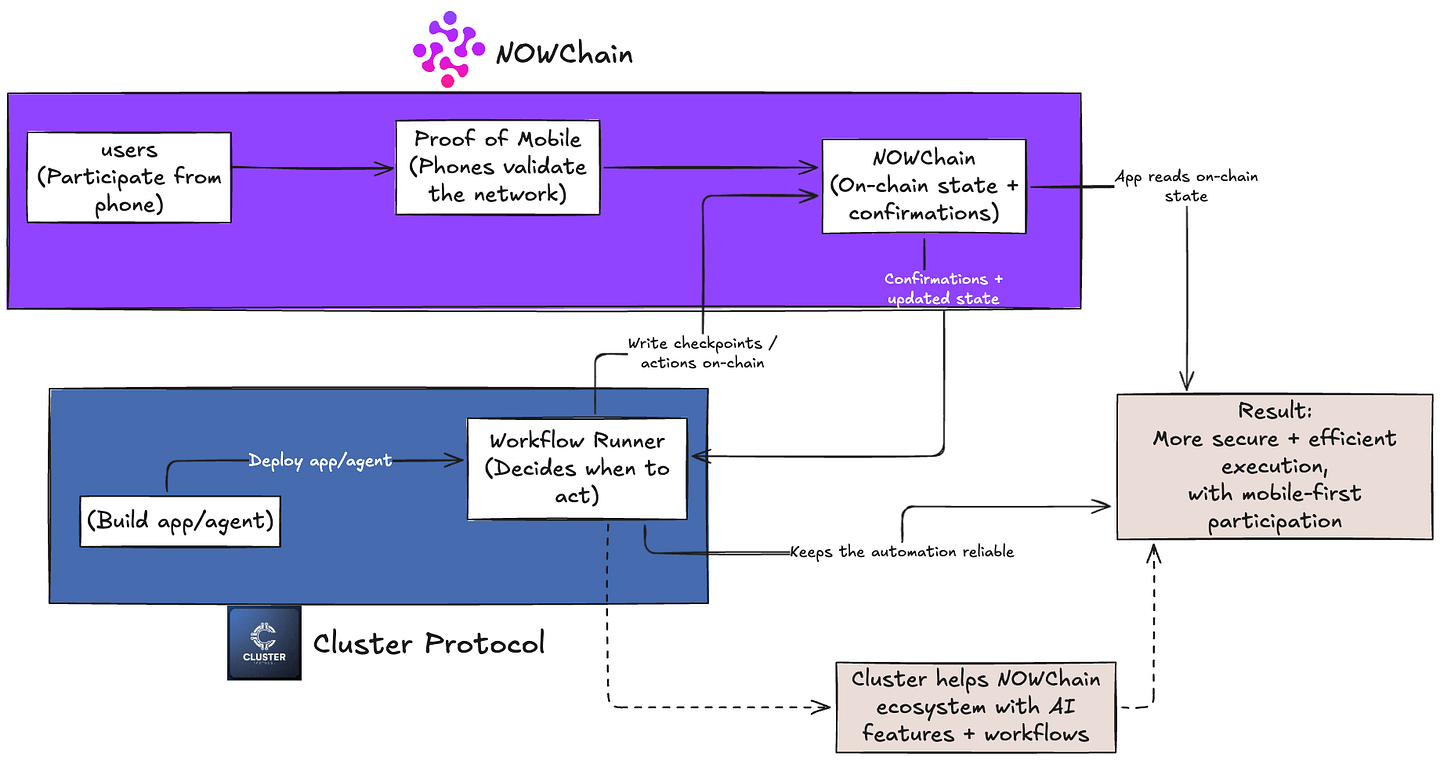
Cluster and NOWChain are building different layers of the same future: decentralized systems that can run continuously, securely, and at scale.
Cluster focuses on decentralized AI infrastructure: verifiable compute, privacy-preserving execution, and orchestration for models/agents/workflows.
NOWChain focuses on mobile-native validation through Proof of Mobile (PoM) positioning smartphones as first-class participants in transaction validation and network security.
Together, this partnership explores how a high-participation, mobile-first network can complement decentralized AI execution and security assumptions.
Core Synergies
Exploring Proof of Mobile as a trust & distribution layer for AI deployments
NOWChain's PoM narrative is centered on widening participation and reducing the energy footprint by leveraging mobile devices in the consensus process.
Security angle: NOWChain's research points toward tying security to mobile-device primitives (for example, discussions around device identity and mobile security methods).
Efficiency angle: PoM is framed as lower-energy participation vs heavier consensus mechanisms, which matters if you want networks to stay active at scale without pushing infrastructure costs upward.
Accessibility angle: if validation is mobile-first, the validator surface area can be broader useful for networks that want high participation rather than "only specialists run nodes."
Cluster supporting NOWChain's AI development (future-facing)
As NOWChain grows its ecosystem, there's a natural opportunity for Cluster to support AI development in the future especially around:
- agent-driven user experiences (assistants, automation, smarter dApp workflows),
- scalable AI execution patterns that don't depend on centralized infrastructure,
- modular orchestration for "always-on" systems (monitoring → decision → action loops).
This is less about "adding AI" and more about giving NOWChain's ecosystem a path to AI that remains verifiable and composable.
What This Enables
For Builders
- A credible direction for building consumer-first dApps where distribution and participation can be mobile-native (via NOWChain's mobile gateway patterns).
- An ecosystem narrative that's easier to explain to normal users: "your phone participates," not "run servers and manage DevOps."
Future potential: agent-based apps that can run continuously on decentralized rails, rather than being "a UI on top of centralized workers."
For the DeAI ecosystem
- More experimentation space around new trust models (mobile-first validation) that could complement decentralized AI execution assumptions.
- A greener, more accessible participation story for networks that want high throughput without energy-heavy designs.
About NOWChain
NOWChain describes itself as a blockchain initiative centered on Proof of Mobile (PoM), where users can participate through PoM-enabled mobile apps that validate transactions and earn rewards.
Their official mobile entry point, mobiNODE, is positioned as a self-custodial wallet plus a way to participate in validation.
Public-facing materials circulating about NOWChain cite early traction metrics such as 4.26M+ connected wallets, ~550K daily transactions, and 63M+ monthly testnet visits (these are widely repeated in third-party coverage; we treat them as "publicly reported" rather than independently verified).
About Cluster
Cluster is the decentralized AI infrastructure powering the Liberation Engine for Internet Capital Markets.
It provides verifiable compute (PoAC), privacy-preserving execution (FHE/ZK), and modular AI orchestration, enabling developers to turn natural-language prompts into production-grade, tokenized dApps via CodeXero, Cluster's AI-native IDE.