
Cluster Protocol × UnifAI: Giving Builders an Easier Way to Create Agentic DeFi Products
Mar 30, 2026
4 min Read
Why this partnership makes sense
There's a lot happening in DeFi right now around automation, agents, and strategy execution. The problem is not a lack of ideas. The problem is that most of these flows are still hard to package into something a builder can turn into a usable product quickly.
UnifAI is building infrastructure for agentic finance, a platform where AI agents can discover tools, execute DeFi actions, and automate strategies across areas like trading, liquidity provision, and borrowing/lending. It also positions its platform around a unified API and developer SDK for teams that want to build on top of that system.
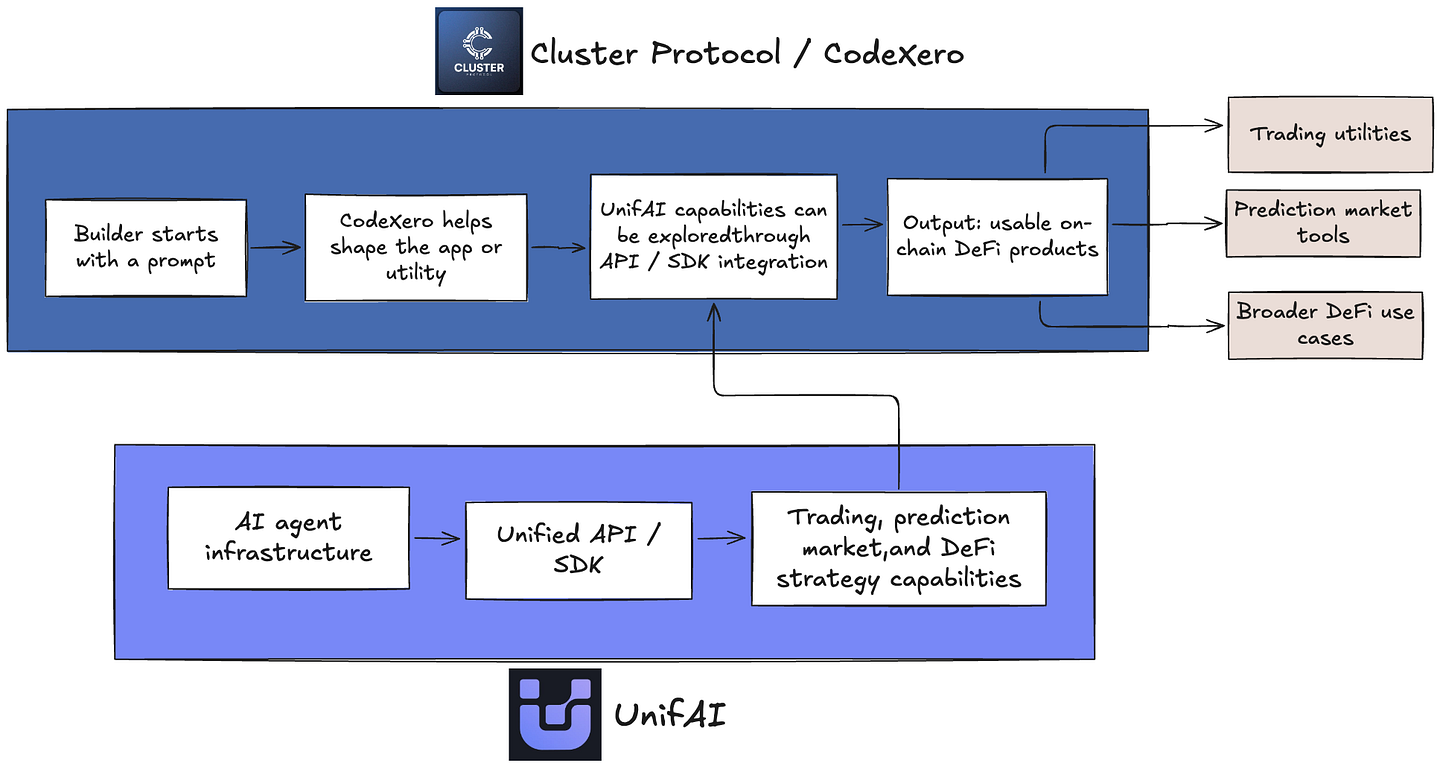
Cluster, through CodeXero, is focused on making on-chain product creation easier and more accessible. So the shared opportunity here is straightforward: explore how UnifAI's agent layer can be surfaced inside CodeXero, so builders can create more useful DeFi products without having to wire every moving part themselves.
Shared Direction
This is not a case of two teams doing the same thing. It is more a case of two teams working on neighboring parts of the same stack.
UnifAI is building the agent and execution side of the experience. On its website and docs, it talks about autonomous operation, dynamic tool discovery, an always-on runtime, and orchestration across a wide range of DeFi tools and protocols.
Cluster is working on the creation side: helping users go from an idea or prompt to an actual on-chain product through CodeXero.
Put together, the direction here is simple. UnifAI can help supply the agent capabilities. CodeXero can help make those capabilities easier to turn into apps, utilities, and user-facing workflows.
Core Synergies
Bringing UnifAI's agent layer closer to the builder flow
The main technical opportunity is to explore how UnifAI's APIs or SDKs could be used inside CodeXero.
If that path makes sense, builders would not just be starting from a blank page. They could potentially use UnifAI's agent infrastructure as part of creating products around trading, prediction markets, and other DeFi use cases. That matters because UnifAI is already publicly framed around strategy automation, unified tool access, and agent-driven execution across DeFi.
This is the part that makes the partnership interesting. It is not just "AI plus DeFi." It is the possibility of making agentic DeFi functionality easier to access inside a prompt-driven creation environment.
Creating room for more builder experimentation
If the technical alignment is strong, a bounty program could help both teams learn faster by getting more builders to test real use cases. Instead of talking about possibilities in the abstract, that would create a way to see what people actually want to build when UnifAI's automation layer meets CodeXero's product-creation flow.
That kind of activity is useful because it turns a partnership into something people can participate in, not just read about.
Aligning on the integration path
The immediate next step is not to overstate what already exists. It is to line up on the basics: APIs, SDKs, access, and what the right integration path looks like.
That makes this partnership practical. UnifAI already presents itself publicly as a developer-friendly platform with a unified API, SDK support, and modular infrastructure. That gives both sides a credible starting point for evaluating how the integration should actually work.
What This Enables
For builders
This creates a possible path for builders who want to create DeFi products around automation, execution, and market logic without having to build the agent layer from scratch.
If the integration moves forward, CodeXero could act as the entry point for creation, while UnifAI could provide the agent capabilities underneath. That is especially relevant for builders looking at products tied to trading, prediction markets, research flows, and other DeFi utilities.
For the broader ecosystem
At a bigger-picture level, this partnership points to something useful: agentic finance becomes much more interesting when more people can actually build with it.
UnifAI's public positioning is already centered on autonomous agents, strategy automation, and unified DeFi tooling. CodeXero adds a more accessible creation layer on top of that. Together, that creates more room for experimentation, faster product iteration, and more practical use cases across the ecosystem.
About UnifAI
UnifAI describes itself as AI-native infrastructure for the age of agentic finance.
Its public site and docs highlight features such as strategy automation, dynamic tool discovery, a unified API, developer SDK support, client-side handling of sensitive data, and an always-on execution layer for DeFi automation.
About Cluster
Cluster is the decentralized AI infrastructure powering the Liberation Engine for Internet Capital Markets.
It provides verifiable compute, privacy-preserving execution, and modular AI orchestration, enabling developers to turn natural-language prompts into production-grade, tokenized dApps via CodeXero, Cluster's AI-native IDE.