
Cluster Protocol's May 2026 Recap
Jun 9, 2026
4 min Read
The month building onchain stopped requiring a team.
If you had to compress May into a single sentence:
@CodeXero_xyz v2 went live on Base, and the rest of the month was the ecosystem rearranging itself around that fact. A flagship shipped, real applications got built on it in days, three new infrastructure partnerships plugged in behind it, and our Roundtable series turned into one of the most-watched conversations in open-source AI. Here is everything, in one place.
The headline: CodeXero v2 is live on Base
New here? The full guide on how to get started and become part of v2: step by step:

You build from your browser. You deploy to Base mainnet. You earn XP, climb a leaderboard, and carry a reputation that lives onchain.
No local environment, no full engineering team, no deep Solidity background required. The entire loop: idea, build, deploy, distribute, now happens in one place.
v2 shipped as a system:
A builder reputation layer: every person shipping onchain accrues verifiable, portable reputation rather than starting from zero on every new project.
CodeXero Tracks: ongoing builder programs for developers and creators building real applications on Base.
XP, badges, and a leaderboard: progress is legible, public, and rewarded.
Connect a Base wallet, link X and GitHub, and you are building inside of a minute. That is the bar v2 set: the distance between "I have an idea" and "it is live on mainnet" is now measured in hours.
The launch was the single largest moment either account had all month, by a wide margin, the kind of response that tells you the market was waiting for exactly this.
Tracks: Vibecode Your Way Onto Base
A core piece of that system is CodeXero Tracks, think of them as mini hackathons. Each Track is a themed building challenge open to literally everyone: vibe coders, creators, and complete beginners alike.
Pick one, ship something real on Base, and earn XP and badges as you go. Just an open lane to build, compete, and get rewarded in real cash, and Mac minis, AP Watches etc. The pilot hackathon is live at https://www.codexero.xyz/tracks/build-in-public-on-codexero🔗
CodeXero Tracks:
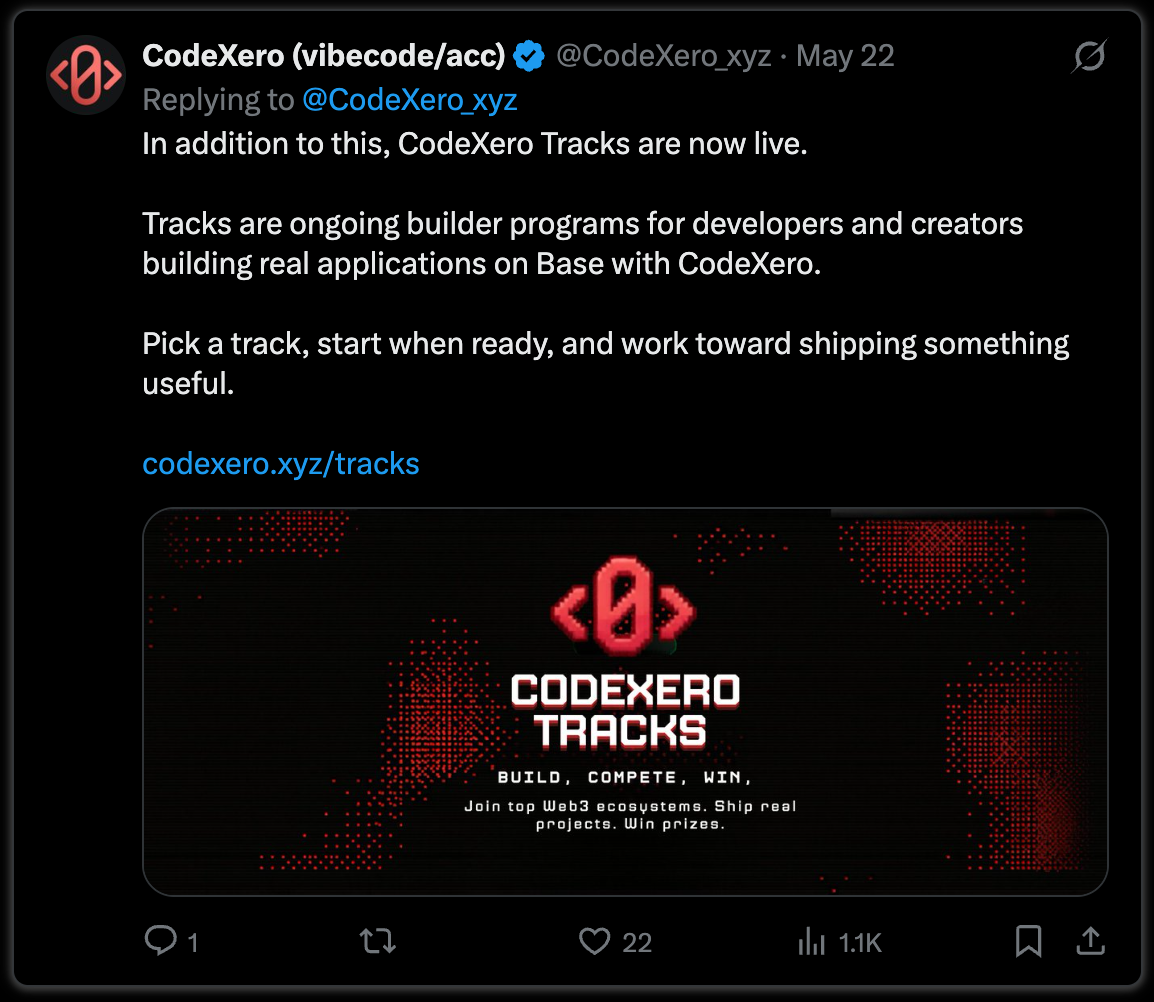
Browse the live Tracks and pick one to start building: https://www.codexero.xyz/tracks🔗
The $2,000 USDC creator campaign
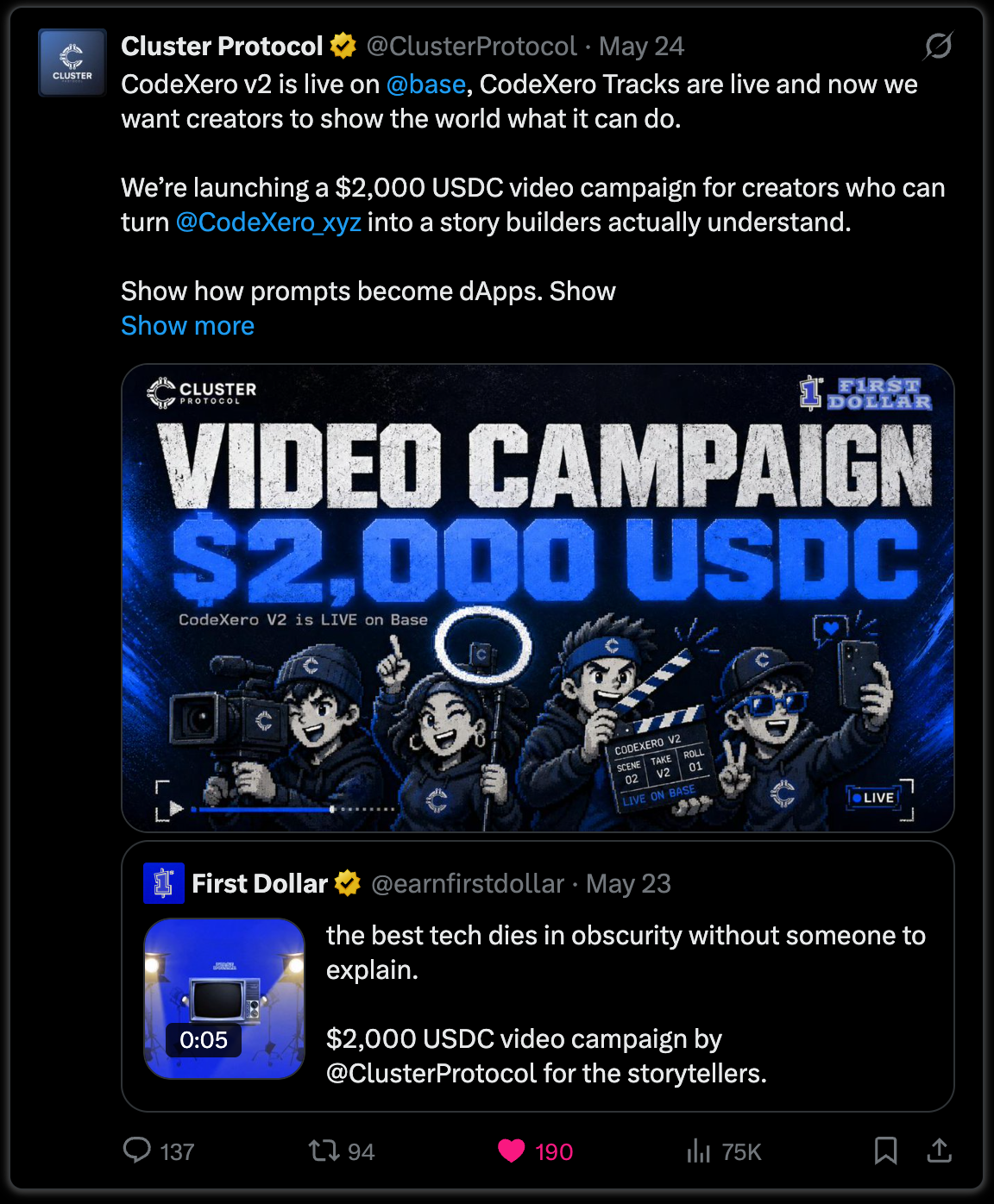
To put it in front of the people who could show it off, Cluster launched a $2,000 USDC creator video campaign🔗, 45-to-80-second videos showing what CodeXero v2 can do, from product walkthroughs to builder explainers.
What people actually built
The most convincing argument for a builder platform is not a feature list. It is what people build on it, fast. In May, two of them stood out, both built on CodeXero.
Fairy Drop went from idea to a working campaign platform on Base in a single weekend. Crypto was never short on ideas; it was short on people able to ship them fast enough. Fairy Drop is what closing that gap looks like in practice.🔗
AnonWall is an open, anonymous notebook built on CodeXero simply by chatting with AI🔗, a place to post a secret, a confession, or a hot take where no one knows who wrote what and nothing can be quietly changed after the fact.
Different use cases, same lesson: the platform turns a description into a deployed, onchain application, and it does it in a weekend, not a quarter.
The ecosystem expands
Cwallet🔗: 60+ chain super-app with millions of users; payment and distribution rails for CodeXero builders🔗.


UXLINK🔗: largest Web3 social platform; social APIs inside CodeXero, social graph on Cluster's data marketplace.🔗

The conversation
Rise of Agentic AI:🔗 "The line between AI assistants and autonomous systems is disappearing."
Sharp minds like Saad Alenezi🔗, Founder/CEO, LLMTune.io🔗, and Joshua J. Bouw🔗, Head of AI, Unicity🔗 and many more in AI infra at one table breaking down the move from assistants to autonomous systems.
Open source at the model layer:🔗 What "open source AI" actually means today.
Trust and ownership:🔗 "Can you trust an AI that runs on someone else's servers? Your prompts, your data, your business."
An infrastructure layer and an application layer
Step back and the architecture of the month is clear. Cluster is the infrastructure-and-narrative layer. CodeXero is the application layer that sits on top of it. Inference, compute, the data marketplace, and x402 live below; the browser-native build-and-ship experience lives above; and everything builders create lands on Base.
Looking ahead
The foundation is set: a flagship that is live and being used, an infrastructure layer that keeps absorbing what builders need, and a community conversation that is growing month over month. The work now is to keep the distance between idea and deployment shrinking, and to keep making the proof, not the promise, the loudest thing in the room.
If you built something on CodeXero🔗 this month, it belongs in next month's recap. Connect your Base wallet, link X and GitHub, and start shipping.
Cluster Protocol, orchestration layer for autonomous workflows, and the Private AI infrastructure behind CodeXero, the browser-native build-and-ship IDE for EVM. Built on Base.