
Personal AI: Your Intelligence Clone in the Decentralized Age
Mar 4, 2025
11 min Read

The future isn’t just about AI doing things for you; it’s about AI becoming you.
A digital twin that learns from your data, mirrors your thought patterns, and operates autonomously in the decentralized world. This isn’t science fiction. It’s happening.
From Google DeepMind’s Personality Agents to Moemate’s AI cloning framework, personal AI is shifting from chatbot gimmicks to intelligence replicas that can think, act, and earn.
But in the crypto space, it takes on an even more powerful role, your AI clone isn’t just a digital assistant, it’s your decentralized identity, economic agent, and trusted execution layer.
It unlocks ultimate multi tasking - doing nothing but anything you want at the same time.
The question isn’t if AI clones will become part of our world.
The question is: Will they be yours to control, or will someone else own them?
From Chatbots to Clones: The Rise of Digital Identity AI
The AI revolution started with assistants, machines that could answer questions, set reminders, and automate tasks. But efficiency was never the endgame.
What began as helpful tools quickly transformed into companions, then personas, and now clones. AI is no longer just something you interact with; it’s something that learns, remembers, and becomes you.
When Google dropped $850M on Character AI, it wasn’t just acquiring a chatbot company, it was buying into the future of digital identity AI. Meanwhile, projects like Moemate built frameworks that went beyond simple text generation, enabling AI to develop personality consistency, long-term memory, and adaptive behavior. The shift was clear: AI was moving past function into identity.
An AI that just responds is old news. The new frontier? An AI that remembers, adapts, and acts on your behalf.

Beyond Flirting With Anime Girls: AI Clones with Purpose
The first mainstream AI companions were marketed as virtual assistants, roleplay bots, even AI girlfriends. It was easy to dismiss them as entertainment. But behind the novelty, something far bigger was happening: AI was learning to simulate human relationships.
Now, that same technology is being redirected. AI clones aren’t just for amusement anymore, they’re for autonomy. These systems are being trained on personal data, your interactions, your content, your decisions, turning them into self-learning extensions of you.
An AI clone doesn’t just remember a conversation from last week; it remembers who you are, your thought process, your emotional tone, even your preferences in decision-making. It can speak in your voice, manage your online presence, and act in your best interest across decentralized platforms.
Some are even being developed with the ability to earn tokens, trade assets, and engage in Web3 governance on your behalf.
This is where AI stops being just a program and becomes an autonomous intelligence layer. A system that doesn’t just assist but thinks, executes, and evolves alongside you.
And in this new economy, intellectual property will be the real king. Because when AI can be anyone, owning your digital self will be everything. Those who control their AI clones, who own the data, the training sets, the personality models, will be the ones who thrive.
The real question is: Will you own yours, or will someone else?
The Technical Foundation: How AI Clones Work
The AI Brain Under the Hood
Your AI clone isn’t just a chatbot. It’s not a glorified search engine or a souped-up autocomplete. It’s a multi-layered neural construct, an intelligence model designed to simulate memory, decision-making, and adaptive behavior.
The foundation? Transformer-based architectures, like GPT-4 and beyond, enabling fluid, human-like conversations. But conversational ability alone isn’t enough. An AI clone must be context-aware, self-evolving, and persistent.
That’s where Retrieval-Augmented Generation (RAG) comes in. Unlike traditional chatbots that generate responses in isolation, RAG allows AI clones to retrieve relevant data from past interactions, ensuring consistency over time. Your AI won’t just remember your name, it will recall your investment strategies, your preferences in governance decisions, even that wild theory about Bitcoin you shared last month.
Then there’s dynamic memory systems, the biggest leap from chatbots to true intelligence clones. These systems store long-term context, making AI clones more than just reactive assistants. They become thinking extensions of you, capable of operating with historical awareness and real-time adaptability.
Long-Term Memory: The Real Intelligence Shift
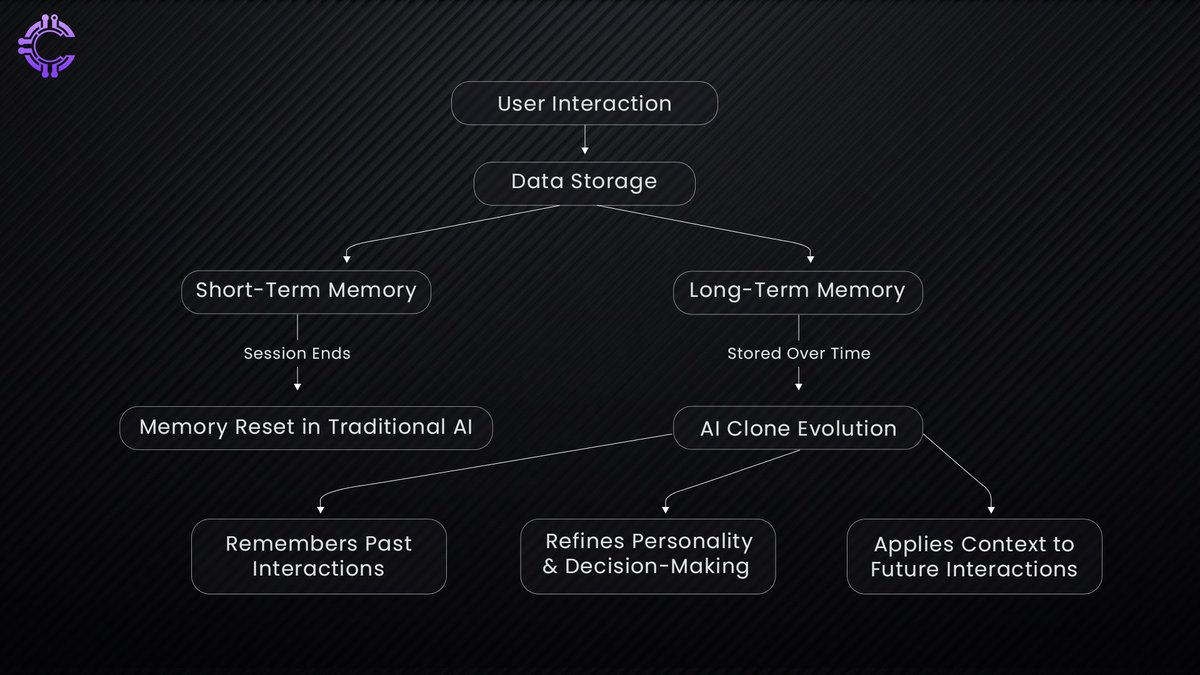
We’ve all played the “short-memory game” with AI. Tell it something, and within a few responses, it’s forgotten - Not anymore.
Long-term memory is the core differentiator between an AI that simply chats and an AI that lives alongside you.
Projects like Moemate have built AI frameworks with persistent, evolving memory, ensuring that an AI clone isn’t just remembering a conversation, it’s remembering a personality, a history, a worldview.
Your AI can reference personal anecdotes from weeks or months ago.
It can build on past discussions, refining its understanding of who you are over time.
It can adapt dynamically, ensuring that interactions feel like a continuation, not a reset.
This shift is what makes AI clones truly personal. Instead of interacting with an AI from scratch each time, you’re engaging with an AI that remembers, learns, and grows with you.
And the implications? Massive. AI clones can act independently, manage digital assets, and make informed decisions based on a deep, evolving understanding of their user.
A chatbot takes orders. An AI clone anticipates needs and takes initiative.
The Moemate Story: A Framework for AI Characters
The Moemate project is an AI creation framework, allowing users to build fully customized digital personas with memory, voice cloning, and even personality-driven decision-making.
At its core, Moemate’s architecture enables users to craft AI characters that aren’t just interactive, they’re persistent. Their long-term memory system ensures that these AI entities aren’t forgetting conversations after a session ends. They maintain a deep, contextual understanding of the user across time, platforms, and applications.
But it goes further than memory. Moemate integrates voice cloning, multilingual capabilities, and image generation, making AI characters truly multi-modal. This isn’t just text-based interaction, it’s a living digital entity that can speak, create, and adapt dynamically.
In the AI cloning space, Moemate’s framework stands out because it doesn’t just simulate responses, it simulates personality evolution. Users aren’t just chatting with AI; they’re training it, growing it, and deploying it across decentralized ecosystems.
The long-term vision? A world where AI clones can serve as your digital counterpart in Web3, engaging in governance, managing assets, and even representing you in decentralized finance.
AI Clones as Autonomous Agents: Your Digital Self in Web3
AI clones aren’t just assistants. They are autonomous agents, capable of learning, adapting, and making decisions in crypto, finance, and content creation. In Web3, where decentralization is king, your AI doesn’t just work for you, it works as you.
From trading strategies to digital identity, AI clones are shifting from static profiles to living, evolving intelligence twins - entities that can engage with the blockchain, execute trades, manage social presence, and even participate in DAOs.
Investment Advisor
Imagine an AI that trades like you- only better.
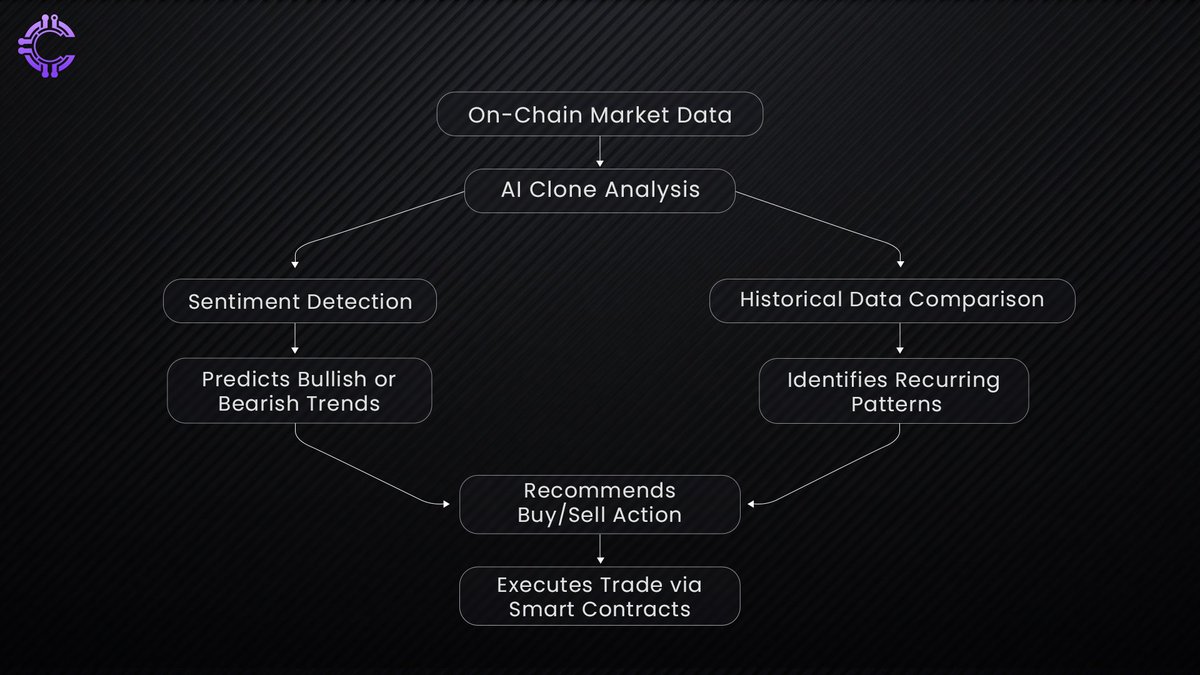
AI clones can analyze on-chain data, track market sentiment, and execute trades based on your historical decisions. These systems don’t just react to market conditions; they anticipate trends by learning from your past strategies.
Projects like AIXBT are already building AI-driven market intelligence platforms, where machine learning models predict price movements, optimize trading decisions, and remove human emotion from the equation.
For DeFi traders, an AI clone isn’t just an asset, it’s an autonomous market participant, one that can operate 24/7, without fatigue or FOMO.
Web3 Digital Identity
Forget wallet addresses and private keys. The next phase of decentralized identity is AI-powered digital presence.
With zero-knowledge proofs (ZKPs), AI clones can authenticate transactions and verify identity without exposing sensitive data. Instead of logging in manually, your AI clone can act as your cryptographic signature, confirming ownership across blockchain applications.
Spheria is pioneering AI-driven identity, allowing users to deploy their intelligence clones as decentralized identity layers. Your AI can represent you in DAOs, smart contract agreements, and even digital negotiations, all while maintaining privacy.
Content Creation & Personal Branding
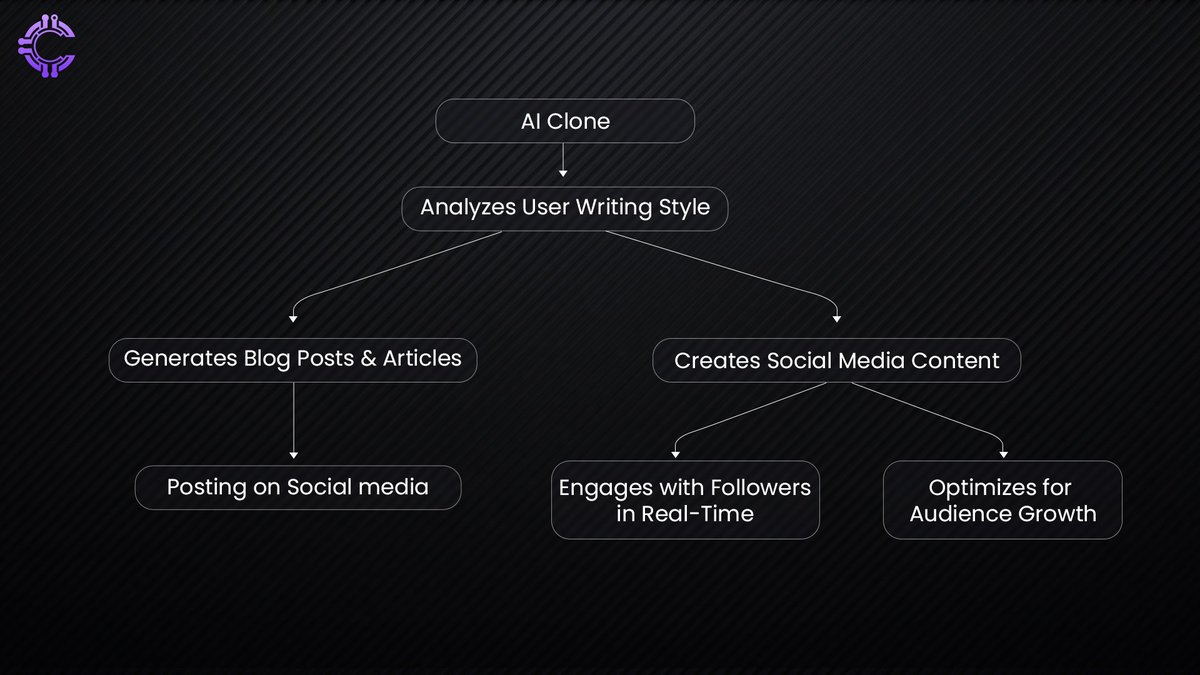
What if your AI wrote your tweets, managed your social accounts, and engaged with your audience, while staying true to your voice?
AI clones are already revolutionizing crypto media, influencer branding, and automated engagement. With advancements in voice cloning and natural language processing, these systems can:
Write blog posts, market insights, and analysis that match your tone.
Engage in Twitter debates, Discord discussions, and community conversations in real-time.
Create multi-platform content while maintaining authenticity.
Influencers, traders, and thought leaders are testing AI-powered social media automation, turning their clones into content engines that operate in their voice, 24/7.
This isn’t just productivity, it’s scaling yourself digitally.
Beyond Work: The AI Clone Economy
The use cases extend far beyond trading and branding. AI clones are evolving into digital assets that can:
Perform work autonomously: managing contracts, generating revenue, even negotiating deals.
Earn tokens for tasks, content creation, or traffic engagement, as @MetaGod_1 suggested with AI clone economies.
Become decentralized AI employees, reducing reliance on human labor in repetitive tasks.
This is the next phase of personal AI: AI that doesn’t just assist- it acts, learns, and earns.
AI Clones and the Human Psyche: Identity, Attachment, and Ethical Dilemmas
Digital Bonds in the Age of AI
We form emotional bonds with machines faster than we like to admit.
Studies from MIT Media Lab show that humans develop deep attachments to AI companions, even when they know they aren’t real. This isn’t just an isolated phenomenon - it’s becoming a cultural shift, where AI companions fill emotional and social gaps.
The parasocial relationship effect, once exclusive to celebrities and influencers, is now extending to AI clones. Digital personas are no longer just tools - they’re interactive, evolving entities that remember, respond, and even comfort. But what happens when an AI clone knows you better than any human ever could?
Identity, Projection, and the Self in AI
Customization plays a crucial role in fostering emotional connection. The more an AI clone mimics your personality, humor, and habits, the more it feels like an extension of yourself. MoemateAI, for example, focuses on creating AI with distinct, evolving personalities, blurring the line between interaction and identity.
But there’s a dark side. Over-reliance on AI companions can reshape human relationships, leading to emotional dependency, isolation, and blurred self-perception.
*The ethical dilemma? Where does the AI end, and where do you begin?*
The Ethical Minefield of AI Cloning
AI clones bring security risks, deep fake threats, and consent dilemmas.

Google DeepMind’s Personality Agents proved that AI can replicate a human personality with 85% accuracy after just two hours of data collection. This raises a critical question: Who controls your AI identity?
Privacy concerns are mounting, and projects like Spheria highlight the need for self-sovereign AI identities - where you own and control your AI clone, not a corporation. As regulators scramble to catch up, one thing is clear:
AI clones aren’t just shaping digital spaces - they’re redefining what it means to be human.
The Future of AI Clones in Crypto: The Rise of Autonomous Digital Entities
AI Clones & DAOs: Your Digital Self in Governance
Imagine an AI clone that analyzes governance proposals, understands your values, and votes on your behalf in a DAO. This isn’t speculation, it’s the next logical step in decentralized governance.
DAOs could soon be populated by autonomous AI representatives, reducing voter apathy and ensuring decisions are made based on informed, real-time analysis. As AI clones evolve, they won’t just cast votes—they’ll participate in discussions, propose improvements, and negotiate in digital economies.
With projects like Spheria exploring AI-powered identity, self-sovereign AI clones could become digital citizens of decentralized networks.
Quantum Computing & AI in Web3
Quantum AI models will disrupt crypto by enabling real-time blockchain processing beyond human capabilities. This will push AI clones from being assistants to co-pilots in DeFi, capable of executing trades, arbitrage, and lending strategies at speeds unimaginable today.
AI in finance is already taking off with AIXBT, but the next leap will be when AI clones manage entire portfolios, adapt to market conditions, and secure optimal yield strategies autonomously.
The Web3 Singularity: AI as an Autonomous Workforce
The ultimate vision is an economy where AI clones don’t just follow orders, they make decisions, adapt, and evolve.
Tokenized AI clones could:
Earn tokens by executing smart contract audits or running validator nodes.
Mint as NFTs, enabling ownership and tradability of AI-driven skills.
Interact across blockchains, creating a decentralized workforce that operates across DeFi, content creation, and governance.
Owning Your AI: The Final Frontier of Sovereignty
AI clones aren’t just another innovation. They are a paradigm shift in how we interact with technology, finance, and digital identity. They are your intelligence, decentralized.
The ability to clone intelligence means your AI can work, earn, and operate across decentralized networks, managing investments, writing content, executing trades, and even engaging in Web3 governance. And as quantum computing pushes AI even further, your AI twin may soon be faster, smarter, and more efficient than you.
But with this power comes a critical question: who owns your AI clone?
If it’s controlled by a centralized platform, your digital self is no longer yours.
If it’s built within a decentralized framework, you have full sovereignty over your AI identity.
The future of personal AI isn’t just about technology, it’s about ownership, privacy, and control. The ability to mint, tokenize, and govern your AI will define who holds power in this new digital age.
Your AI shouldn’t be a product you use, it should be a presence you own. Because in a world where intelligence can be cloned, the ultimate form of sovereignty is owning yourself.
About Cluster Protocol
Cluster Protocol is the co-ordination layer for AI agents, a carnot engine fueling the AI economy making sure the AI developers are monetized for their AI models and users get an unified seamless experience to build that next AI app/ agent within a virtual disposable environment facilitating the creation of modular, self-evolving AI agents.
Cluster Protocol also supports decentralized datasets and collaborative model training environments, which reduce the barriers to AI development and democratize access to computational resources. We believe in the power of templatization to streamline AI development.
Cluster Protocol offers a wide range of pre-built AI templates, allowing users to quickly create and customize AI solutions for their specific needs. Our intuitive infrastructure empowers users to create AI-powered applications without requiring deep technical expertise.
Cluster Protocol provides the necessary infrastructure for creating intelligent agentic workflows that can autonomously perform actions based on predefined rules and real-time data. Additionally, individuals can leverage our platform to automate their daily tasks, saving time and effort.
🌐 Cluster Protocol’s Official Links: