
Understanding the importance of Nodes in a Blockchain and Cluster Protocol's compute node structure for efficient compute sharing.
Jun 17, 2024
15 min Read
Introduction
The eccentric quality of a blockchain is derived from its ability to be decentralized and open. Nodes are important mechanisms in ensuring that the blockchains remain decentralized despite threats from different malicious actors such as hackers, self-interest seeking centralized entities and even the government. Along with other core features of a blockchain like its consensus mechanisms and cryptographic properties, the nodes of a blockchain are the heart of its decentralized system by ensuring proper distribution of data and power across the network.
The article initially explores the nature of nodes in a blockchain, the various types of nodes and lastly their function within a blockchain. Later on, the article discusses Cluster Protocol's disruptively unique node structure that is designed to facilitate large scale compute sharing while lowering costs, enhancing data privacy as well as building a community of similar minded individuals.
What is the role of a Blockchain node?
A blockchain node is a device in the blockchain network responsible for performing important tasks related to the blockchain's functions. Nodes can be thought of as "connections" or
"intersections" in a network that are crucial in maintaining the security, integrity and core decentralized purpose of that blockchain. Nodes can be considered akin to the management of a company. Just like the managers, nodes perform operational tasks within the blockchain. Some of these tasks are discussed below:
1. Maintaining the Ledger
Function: Nodes store and maintain a copy of the entire blockchain ledger. This ensures that data is decentralized and available across the network, enhancing resilience against data loss through a malicious attack or corruption by a centralized party.
2. Validating Transactions
Function: Nodes participate in validating transactions to ensure they are legitimate and adhere to the network's rules. This involves checking that the transaction inputs have not been double-spent and that the digital signatures are valid. To explain using an example;
````Rahul → 5 BTC → Steve
↓
Mempool (a pool of unconfirmed transactions)
↓
Validating transaction````
Digital Signature: Rahul's transaction is signed with his private key. Nodes use Rahul's public key to verify this signature, ensuring the transaction is authentic.
Sufficient Funds: Nodes check the blockchain to ensure that Rahul has at least 5 BTC in his address.
Double Spending: Nodes ensure that Rahul hasn't already spent this 5 BTC elsewhere.
3. Propagating Transactions and Blocks
Function: Nodes propagate new transactions and blocks throughout the network. When a node receives a new transaction or block, it verifies it and then broadcasts it to other nodes, ensuring the entire network is updated. By distributing ledger access to hundreds or thousands of nodes around the world, the blockchain is protected against threats like a cyberattack or corruption of data by a centralized party and enhances privacy, security and the decentralized property of the platform.
4. Consensus Participation
Function: Nodes participate in the consensus process, which is the mechanism through which the network agrees on the state of the blockchain. Depending on the consensus algorithm (e.g., Proof of Work, Proof of Stake), nodes might perform different tasks. A brief preview of the various consensus algorithms is provided below:
Mining (PoW): Nodes (miners) compete to solve cryptographic puzzles to create new blocks.
Validating (PoS): Nodes (validators) are selected based on their stake in the network to create and validate new blocks.
Types of Nodes
Node structures are primarily classified within 2 types: Full nodes and light or partial nodes. In a complex blockchain system, nodes play a variety of important roles and hence different nodes are deployed for various purposes. Below we understand the different types of nodes and their intrinsic functions in depth:
1. Full Nodes
Full nodes are analogous to servers in a blockchain network. The primary function of full nodes is to store and maintain the complete record of all transactions that have ever taken place on the blockchain. Full nodes are considered the servers of a blockchain due to their importance within the ecosystem. Full nodes play a primary role when deciding an amendment in the protocol of the blockchain. Their involvement is imperative in ensuring the blockchain's integrity and security:
Role in Governance: Full nodes participate in the governance of the blockchain. Any upgrades or changes to the blockchain typically require the approval of a majority of full nodes. This means full nodes have voting power and can influence the direction of the blockchain.
Forks: Sometimes, a significant number of full nodes may agree on a modification that doesn't reach the required majority consensus. For instance, if 55% of the nodes support a change while 45% do not, this could lead to a hard cryptographic fork, creating two separate blockchains in which the older blockchain continues to follow the old rules and the rest of the dissenting members form a new blockchain with the new rules.
Categories of Full Nodes:
Pruned Full Nodes: These nodes have a limited storage capacity. They download and maintain the blockchain ledger up to a certain size. When the storage limit is reached, they delete the oldest blocks while retaining its essential metadata to preserve the blockchain's intrinsic properties.
The primary use case of pruned nodes is associated with its ability to be efficient and precise. Pruned nodes are designed to save disk space and naturally require less storage and processing capacity. By leveraging their ability to remove old blocks, pruned nodes can help reduce storage burden on the network while still supporting its security and functionality.
Archival Full Nodes: These nodes store the entire blockchain without any pruning. Archival nodes primarily differ from pruned notes in their capacity to store large amounts of data which naturally requires higher amounts of storage and processing abilities. Archival nodes also differ in their utility as compared to prune nodes. Because archival nodes store all of the past data, they are often required for the purposes of auditing or data analysis.
They are further divided into:
Authority Nodes: Used in permissioned blockchains where certain entities control access and authorize new nodes to join the network. The primary setback of authority nodes is its centralized nature. In an authority node based ecosystem, the identity of node controllers is visible to everyone and a few select nodes hold the power to make significant decisions on behalf of the entire blockchain. Decentralization in this ecosystem is delivered by keeping open and accessible visibility of all the actions of these authority nodes in the network. A prominent example of this system is the membership Service Provider in Hyperledger Fabric.
Miner Nodes: Specific to Proof-of-Work (PoW) blockchains, these nodes mine new cryptocurrency or validate transactions by solving complex mathematical problems. The process requires significant computational power and the miners are rewarded with newly minted cryptocurrency or transaction fees. These nodes play a crucial role in the effective daily operation of the blockchain ecosystem. A good example of such an ecosystem is Bitcoin's Proof of Work based blockchain.
Masternodes: These nodes do not create new blocks but maintain the blockchain ledger and validate transactions. Staking of assets in the form of local coins is required to incentivize masternodes to act legitimately.
Staking Nodes: Used in Proof-of-Stake (PoS) blockchains, these nodes validate transactions by staking their coins as collateral and are rewarded based on their stake and other criteria like coinage or time spent on the network. In a PoS ecosystem, validators are chosen randomly and on factors like the age of their coinage. The Ethereum blockchain utilizes Proof of Stake as its fundamental consensus mechanism.
2. Light Nodes
Light nodes store only the essential data needed for daily operations, such as block headers, without holding the entire blockchain. Light nodes act to ensure efficiency within the blockchains by providing quick processing of tasks that are small and less computationally demanding. They provide quicker access to data for routine transactions but rely on full nodes for complete information and block validation. One can think of light nodes as a local server which only carries limited and relevant information and derives more data from the larger server upon request. Light nodes are also known as Simplified Payment Verification (SPV) nodes and are ideal for users with limited storage and processing capabilities.
Additional Node Types:
Super Nodes: Found in specific blockchains, these nodes perform specialized tasks such as implementing protocol changes or maintaining network rules.
Lightning Nodes: Designed to reduce network congestion and transaction delays, lightning nodes facilitate instantaneous, off-chain transactions, which are later settled on the main blockchain, lowering transaction costs and increasing efficiency. Bitcoin lightning is an example of a layer 2 lightning node that holds significant potential in reducing transaction time and cost of Bitcoin users.
These diverse types of nodes each play a critical role in maintaining the blockchain’s functionality, security, and scalability, ensuring a robust and decentralized network.
In the next section, the article explores Cluster Protocol’s node structure to deliver on its goals of large scale compute sharing.
##Setting-up a node##
Node Architecture
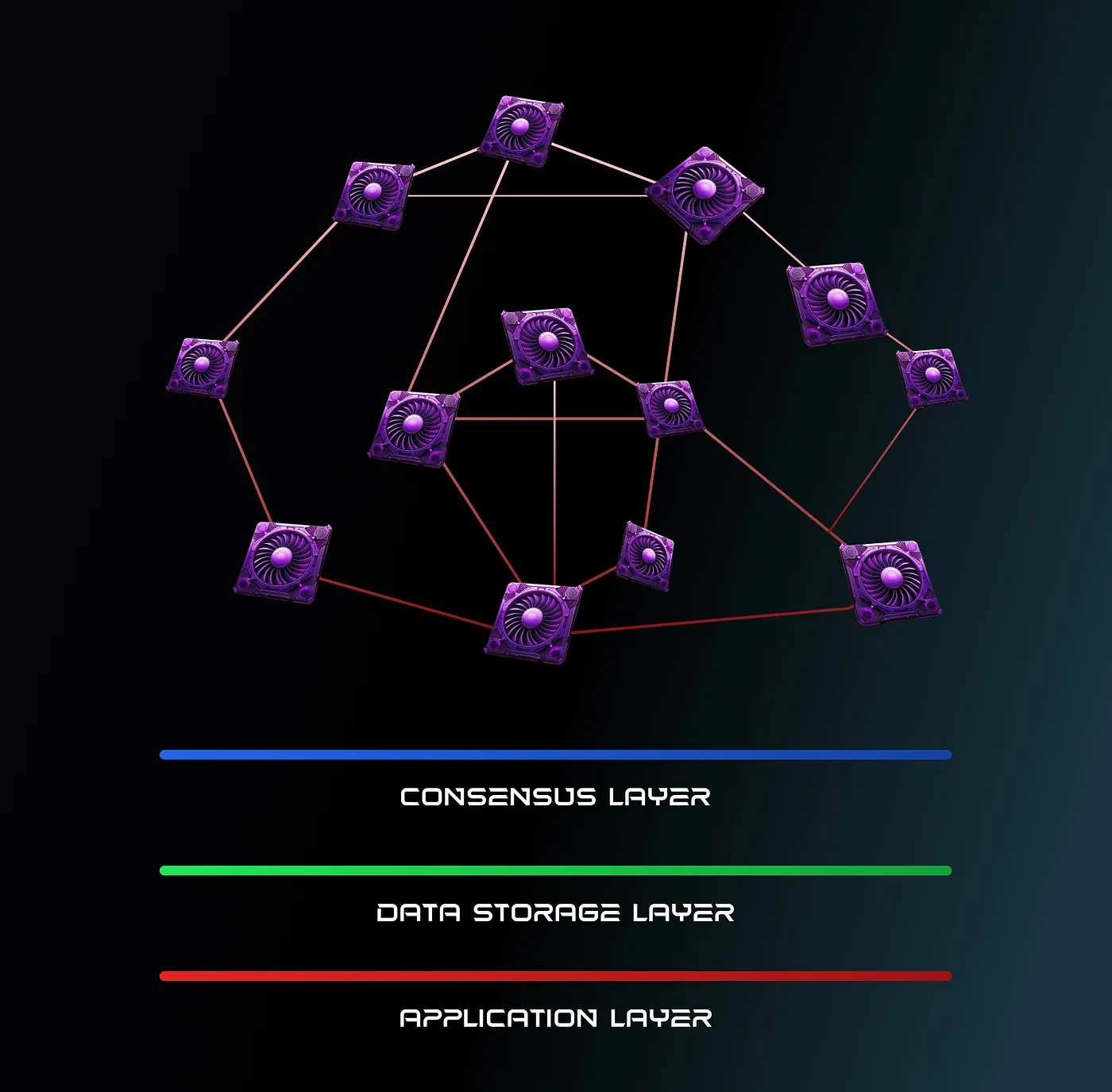
A brief understanding of layers within a Node is important to understand the crucial role layers play in the Node and the overall blockchain. These layers act together to make every Node within a blockchain ecosystem functional.
1. Layers of a Node
Networking Layer: Handles main communication with other nodes in the blockchain network. Uses protocols like TCP/IP and P2P (peer-to-peer) networking to ensure nodes can discover and connect with each other. Essentially the spider web of the blockchain keeping all nodes together.
Consensus Layer: Manages the process by which the network agrees on the current state of the blockchain. Some consensus algorithms include Proof of Work (PoW), Proof of Stake (PoS), and others.
Data Storage Layer: Responsible for storing the blockchain data, which includes the complete ledger of transactions, blocks, and possibly additional metadata. As discussed above, these layers are important in Archival full nodes where complete history of all transactions is stored.
Application Layer: This is where the blockchain’s specific functionalities are implemented, such as smart contracts, APIs for dApps, and user interfaces for interacting with the blockchain. These are usually layer 3 solutions that interact with the underlying blockchain ecosystem. A good example of this would be Ethereum’s smart contracts.
Set-Up and configuration
Node Synchronization
Initial Block Download (IBD): When a new node joins the network, it must download and verify all previous blocks to catch up with the current state. This can be a resource-intensive process, especially for large blockchains like Bitcoin or Ethereum. This process is important in maintaining the integrity, security and legitimacy of the blockchain.
Ongoing Synchronization: After the initial download, nodes must keep up with new blocks being added to the blockchain. This involves continuous communication with other nodes and regular updates to their local copy of the blockchain.
Hardware Requirements
Full Nodes: Typically require a robust setup with multiple CPUs/cores, substantial RAM (16 GB or more), and significant storage space (several hundred GB to multiple TB, depending on the blockchain size).
Full nodes are central figures amongst the blockchain and play an important role in aspects like blockchain governance, ledger record storage, verification of transactions and more.
Light Nodes: As discussed above, light nodes are less demanding, often needing only a fraction of the storage and computational power required by full nodes. Light nodes play a crucial role in their own regards, especially in ensuring minor tasks are executed swiftly without causing a system backlog.
A combination of full and light nodes allow blockchains to ensure effectiveness under maximum efficiency. Yet, many prominent blockchains like Bitcoin have found it significantly hard to manage the activity load and hence layer 2 solutions like Bitcoin Lightning promise to offer a great solution and upgrade to many blockchains.
Software Installation
Below is a very brief discussion of a few prominent node ecosystems and how to install them on your computer:-
Bitcoin Core: Download and install from the official Bitcoin Core website. Follow installation instructions for your operating system (Windows, macOS, Linux).
Geth: Install via package managers like apt-get for Debian-based systems, brew for macOS, or directly from the Geth website.
Parity/OpenEthereum: Download from the OpenEthereum GitHub repository or use package managers. Also make sure to consider specific installation instructions for your operating system.
Configuration Files
Bitcoin Core: Configure settings in the bitcoin.conf file, located in the Bitcoin data directory. Key configurations include specifying network settings, RPC server options, and wallet parameters.
Geth: Use the config.toml file or command-line arguments to set parameters like network type (mainnet, testnet), data directories, mining options, and more.
Parity/OpenEthereum: Customize using a configuration file or command-line flags, specifying network settings, synchronization mode, logging preferences, and more.
Security Considerations
Network Security:
Firewalls: Ensure that only necessary ports are open and properly configured to protect against unauthorized access.
DDOS Protection: Use tools and services to mitigate Distributed Denial of Service (DDoS) attacks, which can overwhelm node resources.
Data Security:
Encryption: Encrypt sensitive data such as wallet addresses and private keys. Use secure methods for key storage, like hardware wallets or encrypted files. Remember, whoever owns the wallet address owns everything in it.
Backups: Regularly back up blockchain data and wallet files. Store backups in multiple locations to prevent data loss and prevent corruption from a malware attack.
Software Updates:
Regular Updates: Keep node software up-to-date with the latest security patches and improvements. Follow official sources for update notifications.
Verification: Verify the integrity of downloaded software using checksums or PGP signatures provided by the developers.
Access Controls:
User Authentication: Implement strong authentication mechanisms for accessing node interfaces, such as RPC servers or management dashboards.
Role-Based Access Control (RBAC): Limit permissions based on user roles to minimize the risk of unauthorized actions.
##Cluster Protocol’s node structure##
Our Node Hierarchy
Cluster Protocol’s node hierarchy ensures a robust, secure, and efficient decentralized AI infrastructure by employing a multi-tiered system of nodes. Each type of node has specific responsibilities to maintain the integrity, performance, and reliability of the network. The primary nodes in this hierarchy for compute are Orchestrator Nodes and Sovereign Nodes.
The node hierarchy of Cluster Protocol, comprising Orchestrator Nodes and Sovereign Nodes, ensures a decentralized, efficient, and secure AI infrastructure. By clearly defining the roles and responsibilities of each type of node, Cluster Protocol maintains the integrity, performance, and trustworthiness of its network. This multi-tiered system of checks and verifications guarantees that all participants can rely on the network’s computational resources for their AI development and deployment needs.
Provider Nodes:
Provider Nodes are nodes that provide computing resources to the network. As the name indicates, they are the “providers” of compute while seeking various incentives from the ecosystem, one obviously being financial reward. Provider nodes in Cluster Protocol’s compute sharing ecosystem play a crucial role by supplying GPU compute resources but are bound to certain standards such as ensuring up to quality up-time. This is assessed using the MLperf benchmarking standard and compute nodes (providers) are chosen at random by our orchestration nodes.
Finally, the results of these benchmarks are included in the verifiability proofs posted on the blockchain. How do these compute providing nodes earn incentives? They do so by earning daily rewards from the PoC (Proof of Compute) pool correlated with the amount of computing power they provide. The best part for them is even if they are not utilized on the network, they would be rewarded, subject to limited reservation from the pool of PoC which constitutes as “Deploy to Earn”.
Validator Nodes:
As the name suggests, validator nodes ensure transactions are safe, legitimate and up-par with our blockchain standards by validating each one of them. Validators act as guardians of the blockchain, verifying transactions and safeguarding the system’s accuracy. Transactions are bundled and distributed to specific validators to ensure they adhere to the network’s rules. These nodes would be accessed by NFT licenses by anyone who owns that license in order to make the network more secure and robust.
How do Validator nodes operate?
Validator node operation concentrates on tasks crucial for network security and state validation:
State Verification: Validators receive compute from various compute provider nodes and perform rigorous verification to ensure its accuracy and consistency before incorporating it into the blockchain.
Challenge-Response Mechanism: The Cluster Protocol Blockchain could implement a challenge-response system where validators compete to solve cryptographic puzzles.
The winner validates the next block and receives a reward, promoting competition and security.
How does one become a Validator node on Cluster Protocol’s blockchain?
Validators acquire Validator node NFT License Keys, granting validation authority and the responsibility to maintain network integrity. These keys function as token-bound accounts (ERC6551 compliant) to accumulate rewards.
Orchestrator Nodes:
These nodes provide oversight for the compute rental process. They assign tasks to provider nodes and perform regular health checks to guarantee smooth operation. Upgrading to this role is possible for Validator Nodes by staking a defined amount of $CP as collateral.
Orchestrator nodes play a crucial role in ensuring the integrity and reliability of the Cluster Protocol blockchain through by regularly doing health checks for compute (provider) nodes. Orchestrator nodes are further governed by sovereign nodes who ensure that an orchestrator node is following the correct procedure to ensure proper distribution of randomness of check amongst all provider nodes.
What are the components of the Orchestrator node?
1. Executors:
Role: Handle the actual computational tasks such as rendering, AI inference, and virtual environments.
Purpose: Ensure high-performance computing with minimal latency, providing a “zero lag” experience by offloading workloads from local devices to the cloud.
2. Verifiers:
Role: Maintain the integrity and performance of Executors by verifying their specifications and performance.
Purpose: Ensure Quality of Service (QoS) within the network, maintaining trust and reliability by validating Executors meet required standards.
3. Coordinators:
Role: Manage resource allocation by matching consumer requests with suitable Executors.
Purpose: Provide near-instantaneous service delivery, ensuring efficient task execution through advanced scheduling and signaling mechanisms.
Sovereign Node:
The Master Node serves as the blockchain’s final arbiter. It validates transactions and adds them to the ledger, guaranteeing the network’s security and irreversibility. Sovereign nodes also play a crucial role in ensuring fairness and effectiveness of the ecosystem by performing the following role and responsibilities:
Sovereign Nodes oversee the activities of Orchestrator Nodes, ensuring that they perform their duties correctly and efficiently. Sovereign Nodes randomly select and verify 1 out of every 1,000 proofs posted by Orchestrator Nodes. This additional layer of verification ensures that Orchestrator Nodes are performing their tasks honestly and accurately.
Sovereign Nodes check the randomness of the Orchestrator Nodes’ verification processes by simultaneously ensuring that the selection of compute nodes for verification is truly random and unbiased.
Data Nodes:
Unlike validator nodes, data nodes likely operate in an open-access manner. Anyone can contribute data nodes to the network, fostering a distributed and community-driven decentralized data storage system.
How do Data nodes participate in the ecosystem?
Open Contribution: Unlike validator nodes, data nodes likely operate in an open-access manner. Anyone can contribute data to the network, fostering a distributed and community-driven decentralized data storage system.
Reputation-Based Incentives: While there might not be upfront licensing, the Cluster Protocol Blockchain could implement a reputation system. Reliable data providers with consistent uptime and accurate contributions could earn rewards or preferential treatment within the network.
How do Data nodes operate within the ecosystem?
Data Registration: Users submit data through designated protocols tailored for efficiency. These protocols might involve data sharding or chunking for distributed storage across multiple data nodes. Keep a note that, the data nodes would be airdropped in future to active validator node operators based on the NFT keys that validator will be using to validate the network.
Storage and Retrieval Optimization: Data nodes are optimized for efficient data storage and retrieval. The network could employ Proof-of-StreetMap (POSM) or similar mechanisms where nodes with better storage capacity and retrieval speeds earn more rewards.
About Cluster Protocol
Cluster Protocol is a Proof of Compute Protocol and Open Source Community for Decentralized AI Models. We are dedicated to enhancing AI model training and execution across distributed networks. It employs advanced techniques such as fully homomorphic encryption and federated learning to safeguard data privacy and promote secure data localization.
Cluster Protocol also supports decentralized datasets and collaborative model training environments, which reduce the barriers to AI development and democratize access to computational resources. Its innovative features, like the Deploy to Earn model and Proof of Compute, provide avenues for users to monetize idle GPU resources while ensuring transaction security and resource optimization.
Cluster Protocol provides an infrastructure to anyone for building anything AI over them. The platform’s architecture also fosters a transparent compute layer for verifiable task processing, which is crucial for maintaining integrity in decentralized networks.
🌐 Cluster Protocol’s Official Links: